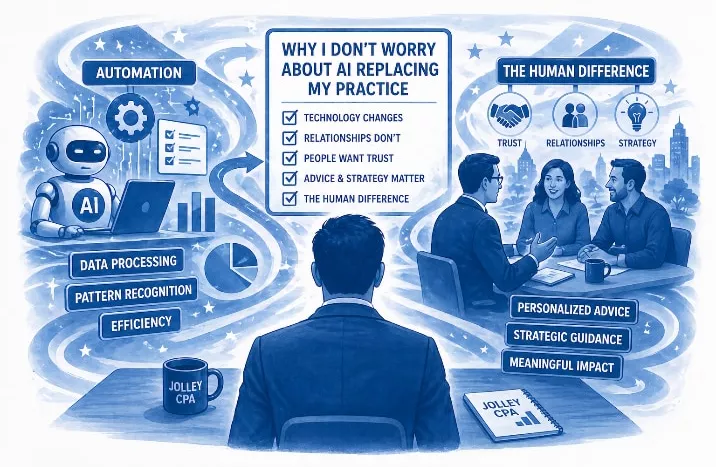
Why I Don't Worry About AI Replacing My Practice
AI can generate fast answers, but in technical fields like tax, plausible is not the same as correct. In this post, Hal Jolley explains why AI makes experienced advisors better rather than obsolete, and why judgment, context, and the ability to spot what is wrong still matter most.
INSIGHT FROM HAL JOLLEY, CPA & CFA
Why I Don't Worry About AI Replacing My Practice
SUMMARY
It's the question I get asked the most these days — and the question some clients are quietly afraid to ask out loud: why do I need a CPA when I have AI? It's a fair question. AI tools have come a long way, and they're remarkably good at giving plausible-sounding answers to almost anything you ask them, including tax questions.
In this piece, Hal Jolley walks through how he actually uses AI in his practice, why expertise matters more in the AI era rather than less, and what most people get wrong about asking AI questions in technical fields. His take: AI is a powerful tool, but tools work best when you already know what you're doing.
“I'm directing it as if I'm its parent — because I know the guardrails and the limits.”
— Hal Jolley, CPA & CFA
The Question I Keep Getting
Some people — and I'll be honest, I don't really love this question, but I get it a lot — ask: why do I need you when I have AI?
My answer is: I do incorporate AI into the business. I use it. The question isn't whether AI is useful. It absolutely is. The question is whether using AI well is the same thing as having expertise. It isn't.
How CPAs Have Always Used Research Tools
You may or may not be familiar with the hierarchy of the tax code, but most CPAs and all tax attorneys avail themselves of services like LexisNexis, where we look at cases that have happened and how courts have ruled — particularly to determine whether a tax strategy is going to stand the test of an audit.
So research tools that summarize and surface relevant information aren't new in this profession. AI is a natural extension of that. One of the ways you integrate AI is the same way you integrate any other research tool: you have to be very knowledgeable on the subject, and you have to know the questions to ask.
The Parent Analogy
It's like any tool. If you know how to use it really well — and you understand its limitations — it can be used very, very effectively. That's a big if.
The reason I can use AI effectively in my business is that I'm very well educated in the tax code. How it works. What things are deductible. What things are not. So when I ask AI tax questions, I have a very good understanding of what I'm asking, and I know where I want it to go.
“I'm directing it as if I'm its parent — because I know the guardrails and the limits.”
That's the difference. I'm not asking AI for the answer. I'm asking it to help me organize information I already have a framework for. I can spot when it's going wrong, because I know what right looks like.
Why It Doesn't Work the Same Way Outside My Field
I'll give you the flip side. When I have a technology problem — a computer issue, something software-related — I'll try to solve it through AI. That tends not to work so well, because I'm not a technologist. I don't know enough to direct the conversation the way I do with tax questions. I can't tell when the answer is plausible-sounding but wrong.
So the big thing about AI is that you can use it really well, particularly in your field of expertise, because it adds to it. Outside your field of expertise, you're more or less hoping the answer is right.
Why This Matters Especially in Tax
The problem many people are going to have specifically in the tax world is that it's esoteric. Technical, in the sense that certain terms have certain meanings. A lot of these terms come from generally accepted accounting principles in the accounting world.
Unless you speak the language, you're likely to spin your wheels with AI — and get solutions that may not match your actual scenario or your need. That's not a knock on the tool. It's a feature of the field. Tax is precise. “Close enough” answers can cost you money or get you into trouble with the IRS.
“Unless you speak the language, you're likely to spin your wheels with AI — and get solutions that don't match your actual scenario.”
Will AI Replace Me? I Don't Think So.
The other question I get is: are you afraid AI is going to replace you?
I don't think it's going to replace me. I think it's going to actually make me better. If I learn how to use the tool and integrate it, it'll make the service I provide clients better.
Look at the history of technological evolution in the United States. Technology has never eliminated jobs in aggregate. It's moved jobs and created new jobs. Everyone was worried that the PC revolution in the late 80s would replace people. It just made more work, because we now had more information, more decisions we could make, and more things we could do with it.
Then we had the dot-com bubble. But the internet has certainly been a boon. I've never heard a story from a client who said the internet put them out of business. It's changed the way you have to do business, and it's provided opportunities. Fifteen years ago, I wouldn't have been introducing myself to you through videos. That's largely part of the technological revolution.
The Bigger Question
The bigger issue is what AI does and how we use it. It probably provides more opportunities, and it probably changes our jobs. But if we use it in the right way, it'll give us plenty of opportunity to improve what we do.
“If we use it in the right way, it'll give us plenty of opportunity to improve what we do.”
That's where I sit on the question. AI doesn't replace expertise. It rewards it. The people who'll be in trouble aren't the experts using AI — they're the people using AI without the expertise to know when it's wrong.
Want to Talk?
If you're thinking about how AI fits into your own financial decision-making — or you're wondering whether your current CPA is using these tools well — a short conversation is the easiest way to talk through it.
More Topics
Financial Insights Business ServicesFinancial ForecastingFinancial PlanningTax PreparationWealth ManagementStart with a Complimentary Conversation
A no-cost discussion to understand your goals, evaluate your current strategy, and outline next steps.
Schedule a Complimentary Call