What a Fractional CFO Actually Does (and Why Most Small Businesses Need One)
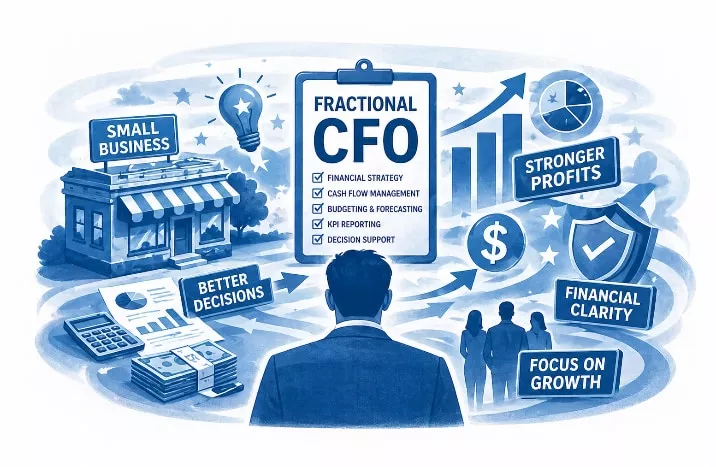
What does a fractional CFO actually do? This post explains how strategic forecasting, cash flow oversight, and forward-looking financial planning help small businesses grow with more clarity and less risk.
INSIGHT FROM HAL JOLLEY, CPA & CFA
What a Fractional CFO Actually Does (and Why Most Small Businesses Need One)
SUMMARY
Most people don't understand what fractional CFO services are, or really what a CFO does. The role isn't bookkeeping. It isn't filing taxes. It's the function that makes sure a business has money available when it needs it, that growth doesn't quietly drain the company's cash, and that the financial story being told to investors and lenders actually matches where the business is going.
In this piece, Hal Jolley breaks down what a CFO is responsible for at a working level, why growing businesses run out of cash even when they're succeeding, and why fractional CFO services exist in the first place — because most small businesses need this kind of strategic financial thinking, but they don't have the capital to hire someone full-time.
“The future is what investors are buying. They're not buying your past.”
— Hal Jolley, CPA & CFA
What a CFO Is Actually Responsible For
Having sat in the CFO chair at multiple companies, I'm intimately aware of how a CFO benefits a company. The primary responsibility is balance sheet management — and that usually involves liquidity, in some type of forecasting into the future, whether it's shorter term or longer term.
Said simply: the CFO's role is to make sure we have money available when we need it. Not in the abstract. Not on a spreadsheet six months from now. Available, when the business needs it, to do what the business needs to do.
“The CFO's role is to make sure we have money available when we need it.”
Why Growing Businesses Run Out of Cash
This is the part most founders learn the hard way. Typically, as a business grows, they're using cash because they're financing additional customers, additional marketing. They're usually holding receivables for new clients longer. So a growing business will oftentimes use cash.
That's the paradox. Your business is succeeding — more clients, more revenue, more activity — and yet there's less cash sitting in the bank than there was last quarter. Growth itself is consuming the runway.
The CFO role is to make sure that it doesn't get out of hand, and to make sure that there's cash or liquidity available to meet the business's needs — like payables, paying our employees. Those aren't optional. They have to happen on time. A CFO is the person who's looking around the corner so the business never gets caught off guard.
The Other Half of the Job: Strategic Planning
CFOs are actively involved in the strategic plan. As a business that's growing, you typically have some objective — you want to grow in a certain way. What CFOs do is they participate in that process. They build a financial model or a forecast that meets those goals, or helps decision-making along the way.
And again, it's about forward-looking decisions. The whole point of the work is to take what we know about the past and use it to make better choices about the future.
“CFOs participate in the strategic plan. They build a financial model or a forecast that meets the goals — or helps decision-making along the way.”
Why Forecasting Matters: Investors Are Buying the Future
Here's the thing most business owners don't fully appreciate until they're in the room with a lender or an investor or a buyer.
The way forecasts benefit businesses is they ultimately dovetail or become part of the plan. This is what we're trying to accomplish. And for growing businesses — particularly those that want to acquire capital, need to acquire capital, or maybe want to sell — the future is what investors are buying. They're not buying your past.
“The future is what investors are buying. They're not buying your past.”
When you have some estimate of the future and you think you can achieve it, and you're bringing on more capital or more investors — they're there for the future. So you have to present something to them that shows how you're going to use their capital, or how they're going to benefit from being in a relationship with you. That's not something you can put together at the last minute. That's the product of months of disciplined forecasting work.
Why Fractional Makes Sense for Small Businesses
That's largely what CFO services are. They're taking the past and figuring out how we can improve upon it, and continue to improve our business going forward. The CFO's focus is forward-looking.
And having sat in that chair, I can help small businesses in a fractional way — simply because small businesses need that service. They just don't have the capital, usually, to pay for the full-time person.
That's the gap fractional CFO work fills. The strategic financial thinking is non-negotiable for any business that wants to grow, raise capital, or eventually sell. The full-time price tag for it isn't realistic for most small businesses. Fractional makes the math work.
“Small businesses need that service. They just don't have the capital, usually, to pay for the full-time person.”
Want to Talk?
If you're running a growing business and you've felt the gap between where your books are and where your strategic financial thinking should be, that's exactly what fractional CFO services are designed to fill. A short conversation is the easiest way to figure out whether it's the right fit.
More Topics
Financial Insights Business ServicesFinancial ForecastingFinancial PlanningTax PreparationWealth ManagementStart with a Complimentary Conversation
A no-cost discussion to understand your goals, evaluate your current strategy, and outline next steps.
Schedule a Complimentary Call