Should a Business Owner Set Up a 401(k)? You're Asking the Wrong Question.
If setting up a retirement plan has been on your list for years, you are not alone. This article reframes the decision, showing why most owners should focus first on contribution level, simplicity, and execution instead of getting stuck comparing plan types.
INSIGHT FROM HAL JOLLEY, CPA & CFA
Should a Business Owner Set Up a 401(k)? You're Asking the Wrong Question.
SUMMARY
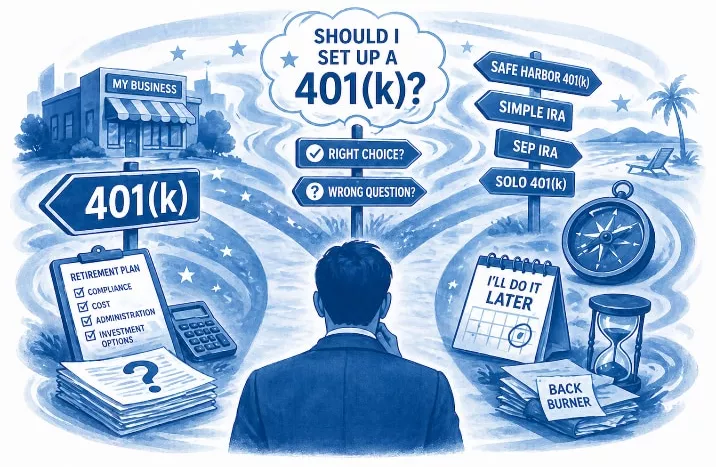
Most business owners I work with have been meaning to set up a retirement plan for years. They know they should. They just haven't — because the decision feels complicated, the options feel overwhelming, and they don't have four or five hours to figure it out. So it goes on the back burner. Year after year.
In this piece, Hal Jolley reframes the entire question. The choice isn't really about which type of plan to set up. It's about how much you're comfortable contributing, and — just as importantly — who's driving the planning process. When you have to call your CPA to start the conversation, the conversation rarely happens. When the CPA brings the conversation to you, the work actually gets done.
“Instead of 4 or 5 hours, you can make a yes-or-no decision — hopefully in just a few minutes.”
— Hal Jolley, CPA & CFA
The Question I Get All the Time
One of the questions I get in financial and retirement planning all the time is: should a business owner set up a 401(k)?
Well — they absolutely should set up something. But they probably shouldn't think of it as just a 401(k). You should look at it more from the perspective that a 401(k) is one type of plan. It's called a qualified plan, and if you do certain things and you follow certain rules, you can get some tax deductibility for having a qualified plan. There are multiple types of qualified plans.
The point is: you should definitely have a plan in place. You don't necessarily have to have a 401(k). You can have other types.
The Real Question Isn't “Which Plan?”
The driver really shouldn't be the type of plan. The driver should probably be: how much am I comfortable contributing?
“The driver really shouldn't be the type of plan. The driver should be: how much am I comfortable contributing?”
Because you may not need a 401(k) if the amounts are smaller. Most people benefit substantially just from an IRA, simply because the IRA limits have been steadily increased over time. So a family with no plan can start with an IRA, and then progress as they become more successful and the business grows — adding other types of plans later.
That's the framework. Start with what fits where you are now. Add complexity only as it becomes worth the complexity.
The Real Value of an Integrated Service
The advantage that CPAs provide in an integrated service is exactly that — a service. When you have wealth management integrated with financial planning and the business, and the financial planner is hired by the same person or the same firm, the advantage to the client is that there's a service component that frees up the client's time.
I can set these things up for you. We can set up processes where money moves automatically. If we're managing the financial statements for your business, we know your cash position. So we know when you have capacity to move and when you don't.
Why This Usually Doesn't Get Done
Here's the part that explains why so many business owners are still putting it off.
If tax planning starts with the client having to make a call — when they have time, or when they think they can fit it in — it often gets put on the back burner. This is true of any type of planning. The bottleneck isn't the work. The bottleneck is the calendar invite that nobody sends.
“If tax planning starts with the client having to make a call when they have time — it often gets put on the back burner.”
The Difference: Yes-or-No in a Few Minutes
When you use us, the goal is that the planning starts with us. We're doing the analysis, then we're calling you and saying: this is what you should do. Do you want us to do it for you?
So instead of 4 or 5 hours of work on your end, you can make a yes-or-no decision — hopefully in just a few minutes. That's the value-add of having someone with this type of expertise on your team.
“Instead of 4 or 5 hours, you can make a yes-or-no decision — hopefully in just a few minutes.”
That's the difference between knowing you should do something and actually getting it done. Most business owners don't lack the desire to set up a retirement plan. They lack the time and the trigger. The integrated approach removes both.
Want to Talk?
If “set up a retirement plan” has been on your list for longer than you'd like to admit, you're not alone — and the fix isn't more research on your end. A short conversation is the easiest way to find out what your options actually look like and how quickly we can have something in place.
More Topics
Financial Insights Business ServicesFinancial ForecastingFinancial PlanningTax PreparationWealth ManagementStart with a Complimentary Conversation
A no-cost discussion to understand your goals, evaluate your current strategy, and outline next steps.
Schedule a Complimentary Call