How the “One Big Beautiful Bill” Could Impact Your Taxes, Investments, and Planning
Sweeping tax legislation can create uncertainty—or opportunity. This post explains how the One Big Beautiful Bill impacts tax rates, capital gains, and long-term planning, and why clarity around the new rules can help individuals and businesses make smarter financial decisions.
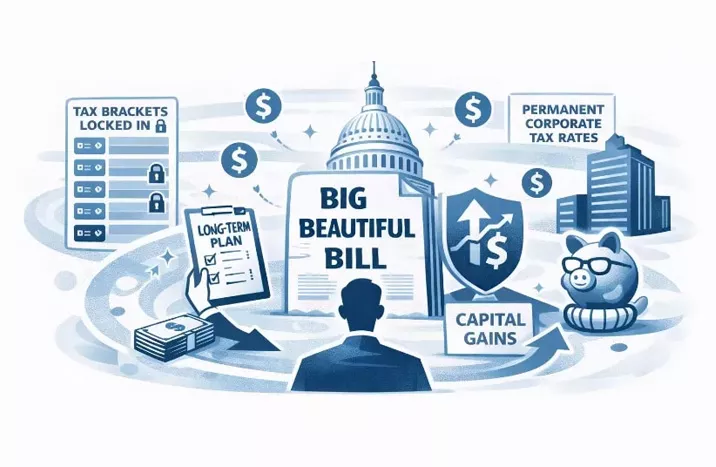
The One Big Beautiful Bill doesn’t just tweak the tax code, it reshapes how individuals should think about long-term financial planning. By locking in tax brackets, preserving favorable capital gains treatment, and making corporate tax rates permanent, the legislation adds a rare element of certainty. That stability creates new planning opportunities, particularly around taxable investment accounts and retirement income strategies. The key isn’t reacting to proposals, but understanding what’s now law and how to use it thoughtfully to your advantage.
The Question Everyone Is Asking About Legislation
One of the most recurring questions I get is about legislation. People ask, what is the current legislation going to look like? What changes do you think are coming? And what should I do about it?
The big bill in 2025, the one commonly referred to as the One Big Beautiful Bill, does change things. Whether those changes turn out to be good or bad will take time to fully understand, but it unquestionably shifts how people should think about planning.
Why Certainty in the Tax Code Matters
One of the most positive aspects of the bill is that it removes uncertainty around tax brackets reverting to pre–Tax Cuts and Jobs Act levels. The new tax brackets are now permanent and indexed to inflation. From both a financial planning and tax planning perspective, that certainty is incredibly valuable.
That does not mean certainty is ever absolute. At some point, another party could control both houses of Congress and make significant changes again. That is always a possibility. But having a stable framework allows planners and investors to make more informed decisions today.
Taxable Investment Accounts Become More Attractive
One important feature of the One Big Beautiful Bill that people should be aware of is how it enhances the long-term appeal of taxable investment accounts. The bill continues to allow for a zero percent capital gains rate, and the income thresholds for that rate are indexed to inflation.
From a retirement planning perspective, it is still true that over long periods of time, you can accumulate more money in qualified retirement accounts. But as this legislation stands, the gap between taxable and tax-deferred accounts narrows.
A major part of investment planning is tax strategy. Many clients hold a mix of taxable accounts and tax-deferred accounts. This bill creates situations where, depending on income in retirement, taxable accounts may allow gains to be realized at very low or even zero tax rates. That alone can meaningfully change planning decisions.
Corporate Taxes and Market Valuations
Another significant component of the bill is the permanent extension of the 21 percent corporate tax rate for publicly traded companies. When the corporate rate dropped from 35 percent to 21 percent under the Tax Cuts and Jobs Act, it increased company profitability on paper by reducing tax expenses.
That change alone increased market valuations. Making that rate permanent adds another layer of certainty for investors. From an investing standpoint, certainty tends to be a positive force.
The Stimulative Intent Behind Tax Legislation
Tax bills like this are designed to be stimulative. In certain situations, overtime pay is now tax exempt. In some cases, interest related to the purchase of a new automobile can be deductible. The bill also expanded charitable deduction options for non-itemizers.
These changes are intended to influence behavior. The goal is to encourage spending, investment, and economic activity. One often overlooked idea in economics is that expectations matter. When people believe the economy will improve, they tend to spend more. That spending helps the economy improve, and in turn, more people benefit.
Why Chasing Proposed Tax Bills Is a Mistake
Unfortunately for my profession, technology has accelerated how frequently the tax code changes. That leads many people to ask what they should do in response to every proposed bill.
In the short term, focusing on tax bills that are still making their way through Congress is often a waste of time. Many proposals never become law. Even those that do may not apply to your specific situation.
The flip side is that some changes that do pass may have no impact on you at all. That is something people often fail to appreciate.
A Practical Framework for Responding to Legislation
I like to apply an accounting concept called known and measurable to legislation. I do not worry much about what is being proposed. I focus on what has actually passed and what is certain to take effect.
Once something is law, we can then determine how to act in our own best interest. From that perspective, the One Big Beautiful Bill does create legitimate financial planning opportunities.
New Opportunities in Tax Planning
One potential strategy created by this legislation is accelerating income or realizing capital gains now, particularly if those gains can be realized at a zero percent rate.
In taxable investment accounts, many people are familiar with tax loss harvesting. This bill introduces the opposite concept in certain situations, known as tax gain harvesting. The idea is to intentionally realize gains while tax rates are favorable.
Executing this properly requires a deeper understanding of portfolio construction. If you sell one investment to buy another, how does that affect your risk profile? Does it change it at all? Are there ways to take advantage of the tax opportunity without increasing risk?
When done correctly, this can be a meaningful value add. But execution is far more challenging than understanding the concept.
The Risk of Acting on Bad Information
To implement strategies like tax gain harvesting, you need current and accurate information. The worst-case scenario is acting under the assumption that gains will be taxed at zero, only to find out later they are taxed at twenty-five percent because the rules were misunderstood.
That is why legislation creates opportunity, but only for those who approach it carefully, thoughtfully, and with up-to-date guidance.
More Topics
Financial Insights Business ServicesFinancial ForecastingFinancial PlanningTax PreparationWealth ManagementStart with a Complimentary Conversation
A no-cost discussion to understand your goals, evaluate your current strategy, and outline next steps.
Schedule a Complimentary Call