Do Election Years Really Matter for Your Investments?
Election years often spark anxiety for investors—but do they really change market outcomes? This article breaks down historical data, common misconceptions, and why disciplined, long-term investing matters more than headlines when politics and markets collide.
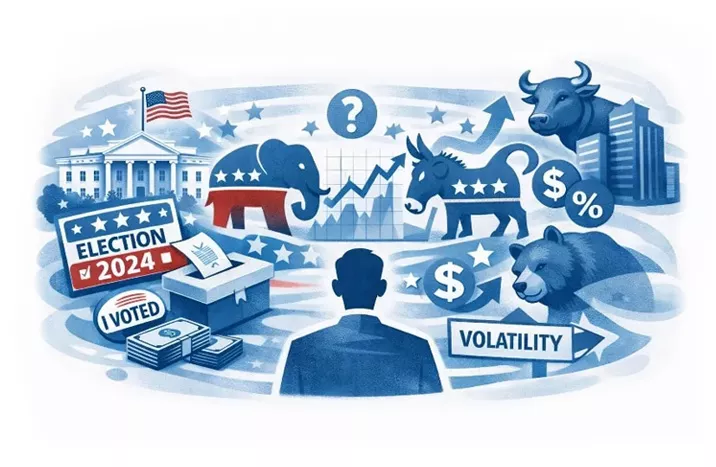
Should elections or political changes affect your investment strategy? Many investors focus on short-term market timing, but history shows that politics and headlines matter far less than long-term fundamentals. The stock market leads the economy, not the other way around, and has grown over time regardless of which party is in power. Learn why reacting to short-term market news rarely pays off, what actually drives market returns, and how to build a disciplined, long-term investing strategy.
Why Most Investment Questions Start in the Wrong Place
Most people, when they’re making investment decisions, tend to ask timing-related questions. The first question is usually, what’s going on right now? What should I do? Should I change my investment philosophy or my portfolio?
The mistake most people make is that very few things actually matter. A common question is, there’s going to be a change in leadership in Washington. A new party is likely going to take over. What does that mean? In a long-term context, it means virtually nothing.
There’s a basic understanding of how the economy really works that most people don’t have, and that’s not a good or bad thing. It’s something we all do. When we don’t really understand something, we tend to ascribe far more complexity to it than actually exists.
The Stock Market Leads the Economy
The reality of capital markets is that they are a leading indicator of the economy. What the stock market is going to do is more likely to tell you what the economy is going to look like, rather than the economy or any one political party telling you what the stock market is going to do. The process is simply reversed from the way most people ask the question.
The stock market, in general, is a leading indicator. If you want to predict the economy, you use the stock market. It’s very difficult, close to impossible, to use the economy to predict the stock market, because historically it works the other way around. People working in the capital markets are constantly trying to figure out where things are going, and that tends to cause markets to move ahead of the economy.
What Actually Drives the Economy
The two basic things that impact all of us economically are monetary policy and fiscal policy. Monetary policy is set by an independent body, the Federal Reserve. Fiscal policy is set by the government.
What most people don’t realize is that Congress is the driver of the budget. Congress holds the purse strings. They send a budget to the President, the President signs off, and while the President does have veto power, Congress ultimately has the authority to override that veto.
What truly impacts the economy over the long term is whether there is a structural change that leads to greater fiscal responsibility. Things like balanced budgets would be great for the economy. And the stock market would likely see that coming before it actually happened. Once again, the market would lead.
The Stock Market Is Not the Economy
A common mistake people make is thinking the stock market is the economy. It’s not. The stock market is simply a way of valuing businesses. It’s a piece of the economy, not the whole thing.
Its purpose is to help companies raise capital, monetize their success, and provide a secondary market so investors can trade shares and use those proceeds to fund their own lives.
It’s also a mistake to think that one political party is going to change everything. If you look at the historical data, the stock market has marched upward over the long term regardless of short-term events. That’s probably not a variable we need to spend much time worrying about.
The Illusion of Control in Investing
I’m fortunate to work with a lot of smart people in this industry and to have learned from people who are much smarter than me. One of the things you have to understand about investing, especially if you’re a small business owner, is that we have a strong desire to do something.
When the stock market goes down, our brains see that as a problem we need to fix. We want to make better decisions. The market can do whatever it’s going to do, but when our portfolio value is going down, it feels personal.
At some level, it’s actually a bit comical. When you look at capital markets from a macro perspective, you realize you have zero control over any of it.
Why Short Term Moves Rarely Matter
At the end of 2024, the total market value of all stock markets in the world was north of 100 trillion dollars. Every single day, sophisticated institutions trade close to a trillion dollars in securities. Prices are adjusted based on the decisions of highly trained, educated professionals operating at massive scale. Roughly one percent of global market value trades every day.
Now compare that to your own portfolio. Even if you’re very successful and have a portfolio of 10 million dollars, any short-term decision you make is irrelevant in a global context. It simply does not move the needle.
What You Can Actually Control
Instead, you step back and focus on the fundamentals. What can you control? You can control how much risk you take. You can control how you define and manage that risk. You can control how much money you put at risk.
What you cannot control is the price or value of securities in the market. That system is far larger than most people realize, and you are not going to impact it at all.
There is also an overwhelming amount of information out there. If someone comes to me and says, I only want you to buy the ones that are going up, I would tell you that is a lot harder than it sounds. Because if we knew which ones those were, those are the only ones anyone would ever buy.
More Topics
Financial Insights Business ServicesFinancial ForecastingFinancial PlanningTax PreparationWealth ManagementStart with a Complimentary Conversation
A no-cost discussion to understand your goals, evaluate your current strategy, and outline next steps.
Schedule a Complimentary Call